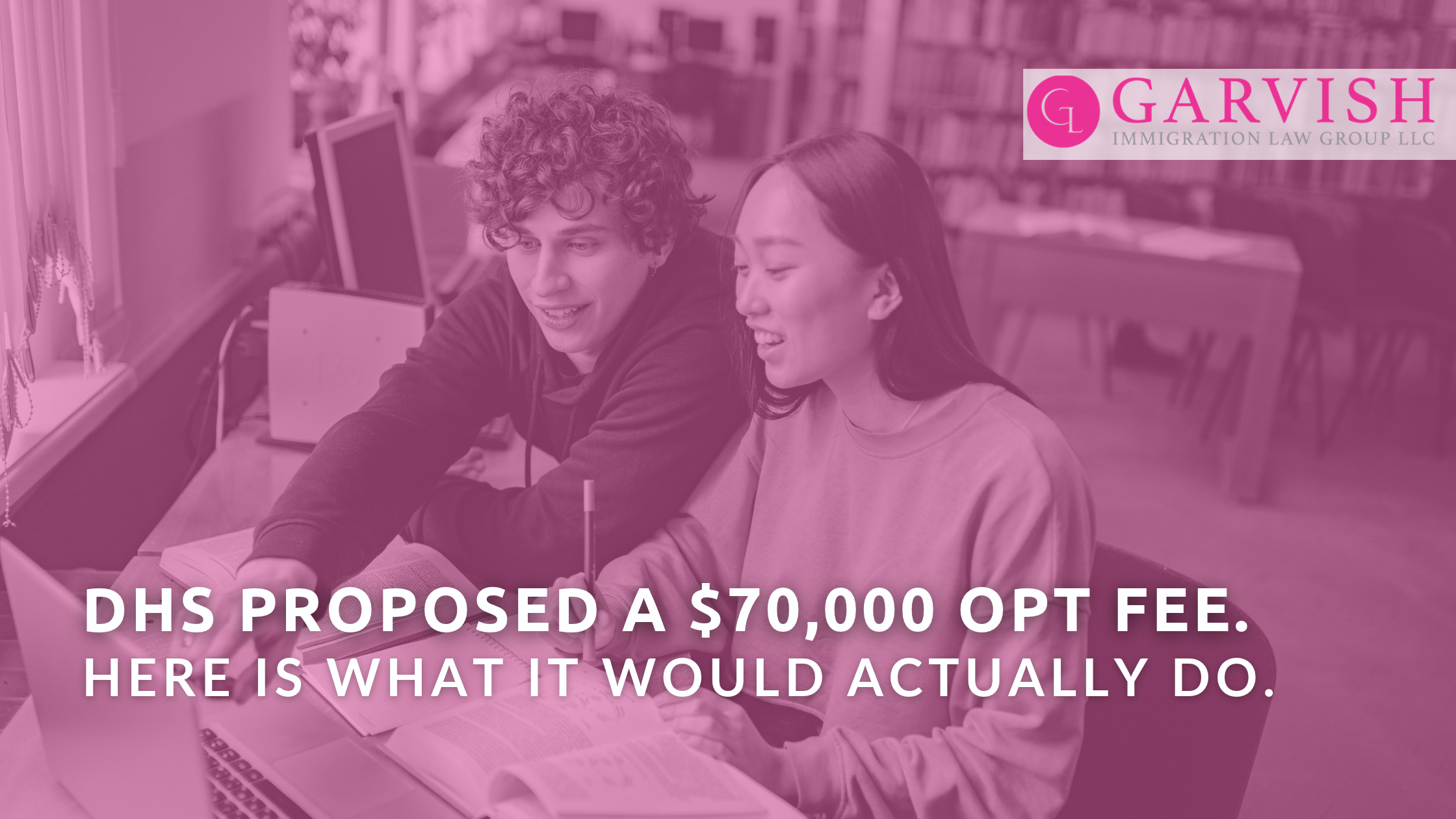
On October 7, 2026, the Department of Homeland Security proposed charging $70,000 for each international student recommended for Optional Practical Training, plus $30,000 for each subsequent recommendation including the STEM extension.
The current filing fee is $520.
The proposal is not in effect, and the public comment period closes on November 9, 2026. Here is what it would do and what you can do about it.
What OPT Is
Optional Practical Training allows F-1 students to work in a job directly related to their field of study, usually for twelve months after graduation. Students in qualifying STEM fields can apply for a twenty-four month extension.
For most international graduates, OPT is the bridge between a US degree and a US career. It is also the pipeline through which many employers meet the people they eventually sponsor for H-1B status.
In 2024, 194,554 students received employment authorization through the program, up from 160,627 in 2023.
What the Proposal Would Change
- Who pays. The fee would be charged to SEVP-certified schools rather than billed to students directly. A school would pay $70,000 before recommending a student for initial OPT, and $30,000 before recommending a student for a subsequent authorization.
- Where the money goes. Into the general fund of the US Treasury.
- What happens in practice. DHS acknowledged in the proposed rule that schools may pass the cost on to F-1 students, to the entire student body, or to employers.
That acknowledgment is the crux of the thing. A university with several hundred OPT recommendations a year would face tens of millions of dollars in new costs. Few institutions can absorb that, which means the realistic options are passing it to students, passing it to employers, or recommending far fewer students.
What DHS Says the Fee Is For
The Department’s stated reasoning is worth understanding, because it shapes what effective public comments will address.
DHS says the fees are meant to reduce fraud and abuse, citing cases its Student and Exchange Visitor Program identified involving schools, designated school officials, employers, and students. It says the fee would incentivize schools to exercise greater oversight and selectivity, recommending only what it called the most promising students. And it stated that without these fees it cannot operate OPT consistent with its focus on preventing fraud and may shut down the program entirely.
What the Data Suggests Would Happen
A survey released by the Institute for Progress found that most international students currently plan to use OPT. If the proposed fees took effect, 80 percent fewer said they would likely try to stay in the United States after graduation. Among STEM students eligible for OPT, only 15 percent said they would likely stay.
Those numbers point past students to the institutions that depend on them. Universities, hospitals, research labs, and technology employers all recruit from this pool. A fee that functionally closes OPT does not only change individual career plans. It changes who is available to hire.
Where This Sits Among Everything Else
This proposal did not arrive alone. International students have faced a remarkable run of changes this year, including the rule eliminating duration of status, tightened CPT guidance, expanded social media vetting, and new form editions with no grace period.
Several of those have been challenged successfully. The duration of status rule was blocked by a federal court in September. The $100,000 H-1B fee was vacated nationwide before being appealed. Courts have engaged seriously with immigration rules this year, and several have not survived.
That is not a guarantee about this proposal. But it is context worth holding onto.
What You Can Do Right Now
The comment period closes November 9, 2026. This is the single most useful action available.
Public comments are a formal part of rulemaking. An agency must consider substantive comments, and a failure to do so has been a successful basis for challenging immigration rules repeatedly this year, including the rule that cost the government the H-1B fee case.
Effective comments are specific. They describe concrete consequences: the student who would not have come, the role an employer could not fill, the research program that loses a contributor, the actual budget math at an institution. Personal and institutional experience carries weight that general objection does not.
The American Council on Education has already announced it will submit comments asking DHS to withdraw the proposal.
If you are a student, keep planning. Nothing has changed yet, and current OPT applications continue under existing rules at the existing fee.
If you are an employer, this is a good moment to look at how much of your early-career pipeline runs through OPT, and to consider commenting from that perspective. Employer voices in these records are comparatively rare and correspondingly valuable.
We Are Here to Help
At Garvish Immigration Law Group, we work with international graduates and the employers who hire them every day. If you have questions about how this proposal could affect your plans or your workforce, or about what options exist if it is finalized, we are here to help.
Reach out to us today.





 English
 Albanian
 Arabic
 Bosnian
 Chinese (Simplified)
 Czech
 Dutch
 Filipino
 French
 German
 Hindi
 Italian
 Japanese
 Korean
 Portuguese
 Russian
 Serbian
 Spanish
 Swedish
 Thai
 Vietnamese