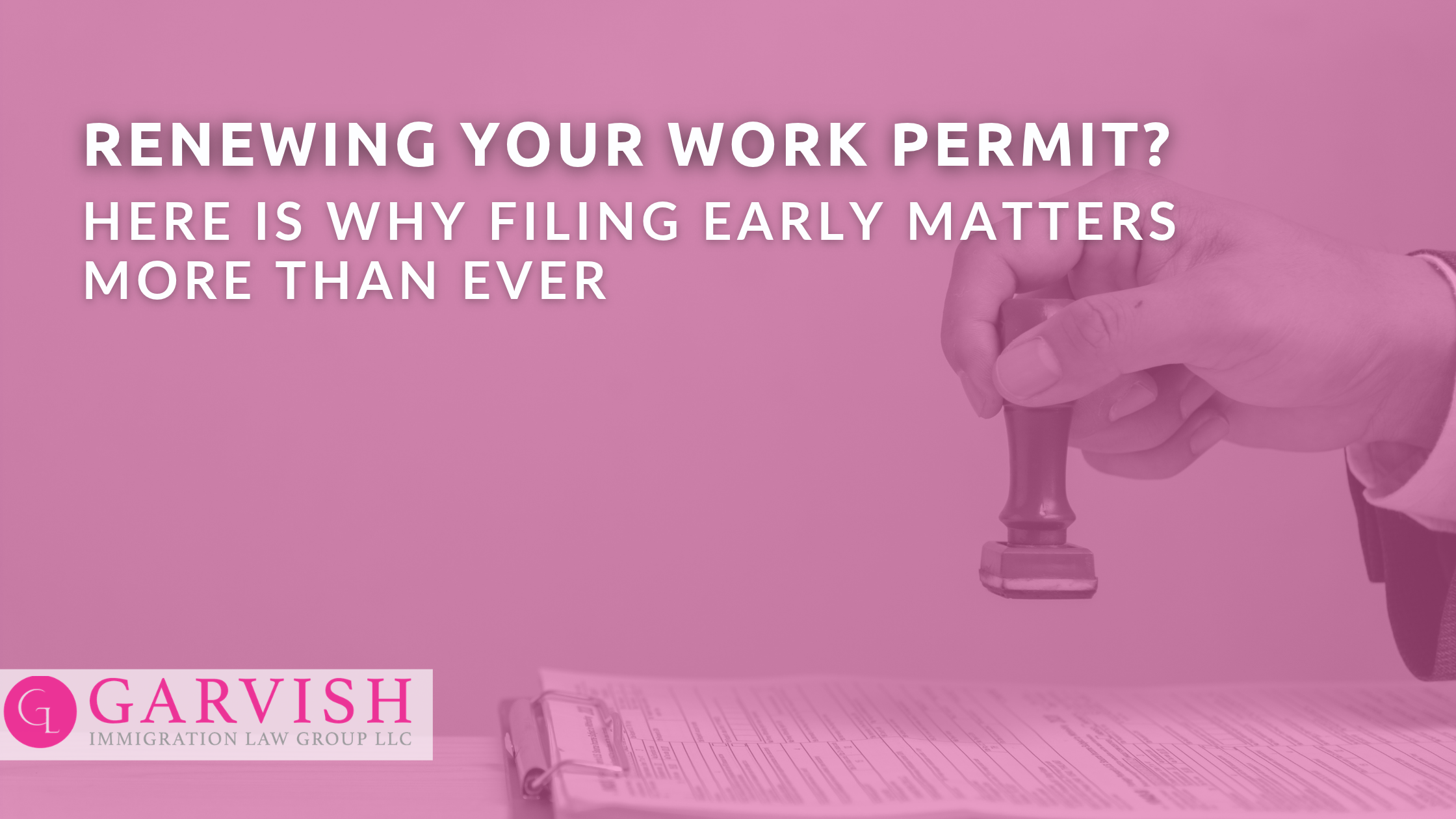
If you work in the United States using an employment authorization card, a recent change is worth a few minutes of your attention. It is not complicated, and once you understand it, there is a clear and manageable way to protect yourself.
On October 14, 2026, the Department of Homeland Security made permanent a change to how work permit renewals are handled. The short version: filing your renewal on time no longer keeps you working while you wait for a decision.
Here is what that means and what we recommend.
What Used to Happen
You would file to renew your work permit. If USCIS took longer than expected and your card expired before they decided, you could keep working anyway. The government granted an automatic extension of up to 540 days, roughly eighteen months, simply for filing on time.
The purpose was straightforward. No one should lose their job because an agency needs more time.
What Happens Now
That automatic extension is no longer available for most renewals.
If your card expires while your renewal is still pending, your authorization to work ends on that date. You would need to stop working until the new card arrives, and then you can pick right back up.
This is not a denial and it does not reflect anything about your case. It simply means the cushion that used to cover processing delays is no longer there.
Who This Applies To
If you work using an EAD, the card labeled “Employment Authorization Document,” this change likely affects you. That includes people who are:
- Waiting on a green card application
- An H-4 spouse of an H-1B worker
- An asylum applicant
- A TPS holder
- A VAWA self-petitioner
If you work on an H-1B, this does not apply to you. The 240-day rule for H-1B extensions is separate and continues to work as it always has.
If you are an F-1 student on STEM OPT, your 180-day extension is also separate and unaffected.
An Honest Note About Timing
The natural response is to file as early as possible, and that is exactly right. It is the most effective thing you can do.
We also want to be transparent about one limitation. USCIS allows renewal filings beginning 180 days before your card expires, and no earlier. As of June 30 of this year, more than 432,000 renewal applications had been pending at USCIS for six months or longer, including more than 91,000 pending over eighteen months.
For most people, filing at the 180-day mark will be enough. For some, it may not be, and if you find yourself in that situation, it is not because you did anything wrong.
Knowing that in advance is what allows you to plan around it.
What We Recommend
Find your expiration date today. Take a look at your card and write the date down.
Count back 180 days and set a reminder. That is the first day you can file, and it is the day to aim for.
Begin gathering documents a month before that. Paperwork should never be the reason a filing is delayed.
Download the form fresh from the USCIS website. Form editions change periodically, and older versions are rejected without a grace period. Starting over costs valuable weeks.
Let your employer know early. If a gap looks possible, advance notice gives both of you room to plan. Some employers can accommodate unpaid leave rather than a separation, but only if they know in time.
Is This Being Challenged?
It is. A group of H-4 visa holders filed suit in January, arguing the change did not follow the procedures agencies are required to follow.
Last month, a federal judge in California agreed and blocked the rule for those plaintiffs specifically, finding that the government had not followed proper procedure and had not adequately considered how much people were relying on the previous rule.
That ruling helped the individuals who brought the case. It did not extend to everyone else, and the rule is currently in effect.
Several immigration rules have been narrowed or struck down by courts this year, and this one may see further challenges. In the meantime, filing early remains the most reliable protection.
For Employers
This is worth building into your existing processes.
Work permit expiration dates can be tracked alongside I-9 reverification, and a reminder to employees before their 180-day window opens goes a long way. Many people are simply unaware the rule has changed.
DHS estimated this change could result in tens of thousands of work authorization gaps and more than $450 million in productivity and turnover costs for employers. A calendar reminder is a small investment by comparison.
The Bottom Line
Your eligibility to work has not changed. What changed is the cushion that made a slow decision easier to absorb.
Mark your date, file as soon as your window opens, and if your card is expiring soon with a renewal still pending, reach out sooner rather than later. There are often more options than people realize.
We Are Here to Help
At Garvish Immigration Law Group, we work with individuals and employers navigating work authorization every day. If you have questions about your timing, a pending renewal, or how to build this into your company’s process, we would be glad to help.
Reach out to us today.



 English
 Albanian
 Arabic
 Bosnian
 Chinese (Simplified)
 Czech
 Dutch
 Filipino
 French
 German
 Hindi
 Italian
 Japanese
 Korean
 Portuguese
 Russian
 Serbian
 Spanish
 Swedish
 Thai
 Vietnamese